Gina Cappuccitti
Senior Director of Housing Access and Stability Services
June 17, 2026
Thank you, Public Housing Committee Chair Banks, Council Members, and Council Central Staff, for the opportunity to submit written testimony on this important oversight hearing on the future of the 5,200 households with NYCHA-administered Emergency Housing Vouchers.
ABOUT NEW DESTINY
Founded in 1994, New Destiny’s mission is to end the cycle of domestic violence and homelessness for low-income families and individuals by developing and connecting them to safe, permanent, affordable housing and services.
New Destiny is the only organization in New York City dedicated exclusively to permanent housing solutions for survivors of domestic violence. We are the largest provider of supportive housing for survivors in New York, and we operate the first and biggest federally funded rapid rehousing program for those impacted by domestic violence in our city. We do this work because domestic violence is the number one cause of family homelessness in our city — and for survivors, housing is a matter of life and death.
We are a co-convener of the Family Homelessness Coalition (FHC), a collective of formerly homeless parents and organizations committed to tackling housing insecurity among families in our city. New Destiny is a member of the Mayor’s Office to End Domestic and Gender-Based Violence (ENDGBV) Advisory Council and the Supportive Housing Network of New York.
Emergency Housing Vouchers
The Emergency Housing Voucher (EHV) program is a federal rental subsidy created in 2021 as a 10-year initiative in the wake of the COVID-19 pandemic to house 70,000 households nationwide, focusing on those in the most dire need, like people living on the streets and survivors trying to flee an abusive relationship. New York City was allocated roughly 7,800 EHVs, which were to be administered by two city agencies: the NYC Department of Housing Preservation and Development (HPD) received 2,050 and the New York City Housing Authority (NYCHA) 5,738. Since then, NYCHA’s active EHVs have declined to about 5,200 households, as some vouchers ended when participants exited the program.
For survivors of domestic violence and the advocates supporting them, the launch of EHV meant far more than another housing program. Unlike local and state subsidies, it was the first large-scale resource people fleeing abuse could access without first entering the shelter system. For instance, it allowed a paraprofessional who could not bring herself to take her disabled daughter into shelter — and had been enduring the abuse to protect her child — to secure a safe home and bypass shelter. It allowed elderly survivors who had suffered decades of abuse from their partner to finally move on and begin to heal.
Because of our demonstrated track record operating a rapid rehousing program funded by the U.S. Department of Housing and Urban Development (HUD), New Destiny was selected by the city to provide voluntary housing navigation to domestic violence survivors referred for EHVs by ENDGBV. In less than two years, we helped house over 700 survivor-led households participating in the program.
New Destiny went a step further and secured private funding to make aftercare, consisting of case management and mental health services, available to the survivors we placed. As a 2025 third-party evaluation documented, survivors strongly benefit from this model. We know firsthand how vulnerable many would be to returning to homelessness — or to their abuser — if they lost their rental assistance.
Termination of the EHV Program
The Trump administration announced in March of 2025 that the $5 billion allocated for the EHV program had run out early and no additional funding would be provided — putting 50,000 households nationwide at risk of losing their homes. HPD and NYCHA were pressed to come up with contingencies. HPD is using another federal subsidy, HOME Tenant-Based Rental Assistance (TBRA), which is a 2-year program, as a stopgap measure for their EHVs. NYCHA had originally planned to use Section 8 Housing Choice Vouchers to help EHV households remain in their homes, but the federal government rejected their proposal.
So far, NYCHA’s only available resource for its 5,200 EHV families — including 1,144 domestic violence survivors and 600 runaway and homeless youth — is to apply for a transfer within its portfolio through the public housing portal. This is not a viable solution on its own. With about 700 apartments, there simply aren’t enough units available. Even where transfers are possible, they would uproot families from the communities they have built — for survivors, the very neighborhoods, schools, and support networks that anchored their lives after fleeing abuse.
We understand that NYCHA is waiting for HUD to approve a plan to use 1,700 HOME TBRA coupons for its EHV households. This would allow some families to remain in their homes, but it would not meet the full need — about 3,000 would still be left with no other option.
New Destiny is working closely with ENDGBV to keep survivors informed. Also, we have been in direct contact with NYCHA, troubleshooting issues case by case. Many of NYCHA’s frontline staff are genuinely committed to making this work — but their hands are tied.
Our Recommendation: CityFHEPS
No single option will keep every NYCHA EHV household housed. NYCHA should continue to offer portfolio transfers for families who want to move, and HOME TBRA, if HUD approves it, would reach about 1,700 families. But units are scarce, and many survivors need to stay in the neighborhoods, schools, and support networks that anchored their lives after fleeing abuse.
Even with these options, roughly 1,500 EHV households — including domestic violence survivors and runaway and homeless youth — would still have no path to remain housed. That is why CityFHEPS must be part of the solution: it is the one resource that can close that gap and keep these families in the homes where they have rebuilt their lives.
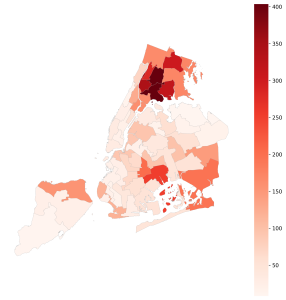
The city must extend CityFHEPS eligibility to NYCHA EHV participants and fund it in the FY 2027 Budget as part of the full program expansion. Today, CityFHEPS eligibility requires a DHS shelter history — a requirement that excludes many EHV participants, especially survivors and youth who found safety precisely because EHV let them bypass the shelter system. A dedicated eligibility category would remove that barrier, allowing EHV households to transition seamlessly to CityFHEPS without anyone being forced back into homelessness. As the map below shows, NYCHA EHV households live in every Council District.
EHV Households by New York City Council District
Source: NYCHA
CityFHEPS would also keep rental income flowing to the thousands of landlords housing these families. And New Destiny is not alone in this call: more than 350 organizations and New Yorkers — most of them directly impacted — have signed our letter urging the Mayor to act, which we hand-delivered at City Hall.
Thank you for the opportunity to share our comments on this crisis. New Destiny remains committed to partnering with the Committee and the Council in any way possible to protect New Yorkers at risk of losing their homes.