
Domestic Violence is a Leading Cause of Family Homelessness |
+ |
Domestic violence is the leading cause of family homelessness in New York City, pushing more families into shelter than evictions. Due to the lack of permanent housing options, which are compounded by the devastating long-lasting effects of abuse, survivors may linger in shelter for years.
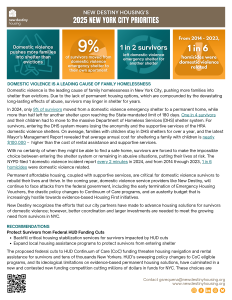
In 2024, only 9% of survivors moved from a domestic violence emergency shelter to a permanent home, while more than half left for another shelter upon reaching the State-mandated limit of 180 days. One in 4 survivors and their children had to move to the massive Department of Homeless Services (DHS) shelter system. For survivors, entering the DHS system means losing the anonymity and the supportive services of the HRA domestic violence shelters. On average, families with children stay in DHS shelters for over a year, and the latest Mayor’s Management Report revealed that average annual cost for sheltering a family with children is nearly $100,000 – higher than the cost of rental assistance and supportive services.
With no certainty of when they might be able to find a safe home, survivors are forced to make the impossible choice between entering the shelter system or remaining in abusive situations, putting their lives at risk. The NYPD filed 1 domestic violence incident report every 2 minutes in 2024, and from 2014 through 2023, 1 in 6 homicides were domestic violence related.
Permanent affordable housing, coupled with supportive services, are critical for domestic violence survivors to rebuild their lives and thrive. In the coming year, domestic violence service providers like New Destiny, will continue to face attacks from the federal government, including the early termination of Emergency Housing Vouchers, the drastic policy changes to Continuum of Care programs, and an austerity budget that is increasingly hostile towards evidence-based Housing First initiatives.
New Destiny recognizes the efforts that our city partners have made to advance housing solutions for survivors of domestic violence; however, better coordination and larger investments are needed to meet the growing need from survivors in NYC.
Recommendations |
Protect Survivors from Federal HUD Funding Cuts |
+ |
- Backfill critical housing stabilization services for survivors impacted by HUD cuts
- Expand local housing assistance programs to protect survivors from entering shelter
The proposed federal cuts to HUD Continuum of Care (CoC) funding threaten housing navigation and rental assistance for survivors and tens of thousands New Yorkers. HUD’s sweeping policy changes to CoC eligible programs, and its ideological limitations on evidence-based permanent housing solutions, have culminated in a new and contested new funding competition cutting millions of dollars in funds for NYC. These choices are leaving New Destiny’s housing navigation program, and hundreds of others, at risk of elimination.
Expand CityFHEPS for Survivors Fleeing Abuse |
+ |
- Fully implement the 2023 CityFHEPS legislative package passed by City Council
- Expand CityFHEPS eligibility to:
- Survivors fleeing domestic violence without requiring a shelter stay
- Survivors regardless of immigration status or family size
- Ensure equitable access for immigrant, LGBTQIA+, older adult, and trafficking survivors
Current CityFHEPS eligibility rules exclude many survivors, particularly those without prior shelter stays, adults without children, and undocumented immigrants. This vital city program needs to work for the most vulnerable and housing insecure people in our communities.
Expedite NYCHA Emergency Transfers for Survivors |
+ |
- Give domestic violence emergency transfers top priority
- Expedite repairs of vacant units to facilitate transfers
- Offer Section 8 or alternative housing options for survivors waiting over 12 months
NYCHA emergency transfers are intended to protect survivors—but delays put lives at risk. Over 75% of pending emergency transfers are related to domestic violence situations. Survivors must wait 1 to 3 years or longer for a transfer. NYCHA places emergency transfers in its lowest priority category, according to the Legal Services NYC’s eye-opening report: Trapped in Danger,
Invest $6 Million in ENDGBV’s Microgrant Program |
+ |
- Invest $6 million in the citywide domestic violence microgrant program administered by ENDGBV
Economic abuse is nearly universal among survivors of domestic violence and is a major driver of homelessness. Microgrants provide low-barrier, flexible financial support that can prevent homelessness. A pandemic-era pilot program run by ENGBV and Sanctuary for Families, showed strong outcomes but was fully depleted in under 2 months. This showcases the need for additional funding to support a program like this, with the ask informed by FJC DV population data.
Reallocate NYC 15/15 Units for Survivors |
+ |
- Reallocate a portion of remaining scattered-site NYC 15/15 units to congregate to allow development of supportive housing for survivors
Supportive housing is one of the most effective interventions for survivors with complex health and trauma needs. After years of advocacy from New Destiny and other organizations, the Adams administration included domestic violence survivors as an eligible population for New York City 15/15, the latest city-funded supportive housing program. However, 100% of NYC 15/15 congregate units have already been allocated, meaning no new DV SH can be developed.