
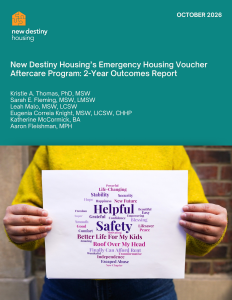
The findings were covered in City Limits: “The Move That Allowed My Kids to Shine’: How Housing Support Helped A Family Heal After Domestic Abuse.” Two years after domestic violence survivors leased up with an Emergency Housing Voucher (EHV), nearly all of them still have it — and most are still in the same home. A new independent evaluation of New Destiny’s EHV Aftercare Program finds that vouchers deliver durable housing stability, and that the services wrapped around them need to last far longer than they did.
Background
In 2021, the federal government distributed 70,000 Emergency Housing Vouchers nationwide. New York City received nearly 7,800 EHVs and set aside about 1,200 for survivors fleeing or attempting to flee domestic violence, dating violence, sexual assault, stalking, or human trafficking.
New Destiny was selected by the City to provide Housing Navigation services to survivors referred to the program by the Mayor’s Office to End Domestic and Gender-Based Violence. We helped survivors lease apartments with these vouchers, then offered up to nine months of light-touch case management through the EHV Aftercare Program, alongside long-term mental health therapy in partnership with University Settlement. HUD funded the vouchers and navigation; The Leona M. and Harry B. Helmsley Charitable Trust funded Aftercare and this evaluation. The program ran from January 2022 to September 2024.
The evaluation
Dr. Kristie A. Thomas and a research team at Simmons University surveyed 224 participants and interviewed 26 — two years after move-in, fifteen months after their services ended. Read the first-phase evaluation.
What the evaluation found
The voucher held. 98.6% still had it. 77.5% were still in the same home. Of those who moved to a new ZIP code, 79.5% went to a higher-income neighborhood.
Lives moved forward. Housing stability, financial stability, and safety-related empowerment all improved significantly. 24.7% raised their education level.
Children are doing better. 70.4% of parents reported improved mental health in their children; 65.5% reported better school performance. Connection to children’s services more than doubled.
Survivors wanted more of the program. 82.1% would recommend it. 83.4% needed it to last longer — especially through recertification and transfers, when help was hardest to find.
A voucher alone is not enough. A third had trouble paying for housing. 30.1% experienced abuse since moving in. Only 39.8% rated their mental health as good or better, and ratings declined over the two years — poor mental health at the start was among the strongest predictors of instability two years later.
“I feel like I’m a success story as far as money well spent with the voucher. A kid got his mom back.” — EHV Aftercare participant
What the research team recommends
Housing is the foundation, not the finish line. The report makes five recommendations: increase federal voucher funding and allocate a substantial share to survivors; pair every voucher with long-term, individualized aftercare, screening at lease-up for who needs the most; reduce the burdens the system creates at transfer and recertification; include free, ongoing mental health therapy; and ensure adequate space so children have room to heal.